
AI isn’t just transforming industries; it’s redefining how we build software from the ground up. At companies like OpenAI and Anthropic, AI agents are slashing development cycles from weeks to days by autonomously handling everything from spec planning to debugging and routine coding. But here’s the reality check: slapping AI tools onto legacy teams won’t cut it. True AI-native engineering demands a complete overhaul; a symbiotic blend of human ingenuity and machine efficiency.
We’ll dive deep into creating high-impact AI-native teams. You’ll get actionable steps to hire right, redesign workflows, secure your stack, and shift culture, all while dodging common traps like unchecked hallucinations or burnout. Whether you’re a CTO at a scaling startup or leading engineering at an enterprise, these strategies will help you harness AI to amplify productivity without the chaos.
Why AI-Native Teams Are the Future of Engineering
Traditional engineering teams operate like assembly lines: coders write, testers debug, devs deploy. AI flips this script. Tools like GitHub Copilot, Devin AI, and custom agents from LangChain now automate 40-60% of repetitive tasks, per McKinsey’s 2025 AI report. The result? Engineers focus on high-value work; architecture, innovation, and ethics; while AI grinds the grunt work.
Consider Cursor AI’s real-world impact: teams using it report 2-3x faster iterations on complex features. Yet, hype overshadows pitfalls. A 2025 Gartner survey found 62% of AI-adopting teams faced issues like bias amplification or security breaches due to rushed integration. The fix? Build teams that are AI-native from day one: human-in-the-loop systems where oversight ensures reliability.
Step 1: Build the Right Talent; Systems Thinkers, Not Just Coders
Hiring for AI-native teams starts with a mindset over resumes. Forget the lone-wolf coder; seek systems thinkers who grok AI’s probabilistic nature. These pros treat code as experiments, iterating with data and curiosity.

Hiring Criteria
- AI Fluency: Proficiency in LLMs, agents, and tools like AutoGPT or CrewAI. They debug hallucinations, not just syntax.
- Cross-Disciplinary Skills: Blend software engineers (for execution), ML specialists (for models), and domain experts (e.g., product folks for context).
- Adaptability: Prioritize learners with a track record of upskilling; think bootcamp grads who’ve mastered low-code platforms like Bubble or Replit Agents.
- Soft Skills: Curiosity, ethical reasoning, and collaboration. They thrive in human-AI loops, escalating when AI falters.
| Role | Traditional Focus | AI-Native Focus | Example Tools |
| Software Engineer | CRUD apps, debugging | Agent orchestration, prompt engineering | LangChain, Vercel AI SDK |
| ML Specialist | Model training | Fine-tuning for production, bias audits | Hugging Face, Weights & Biases |
Use AI-powered interviews. Tools like HireVue with LLM analysis score candidates on real-time problem-solving, cutting bias by 30%.
Start small: Aim for a 1:3 human-to-AI ratio initially. At scale, pilot “AI shadows”; agents paired with juniors for mentorship. Case in point: A fintech at Y Combinator used this to onboard 20% faster, per their 2025 demo day pitch.
Step 2: Redesign Workflows; Agile 2.0 with AI at the Core
Legacy workflows silo tasks; AI-native ones are end-to-end and fluid. Shift to cross-functional pods owning ideation to deployment, with AI automating the pipeline.
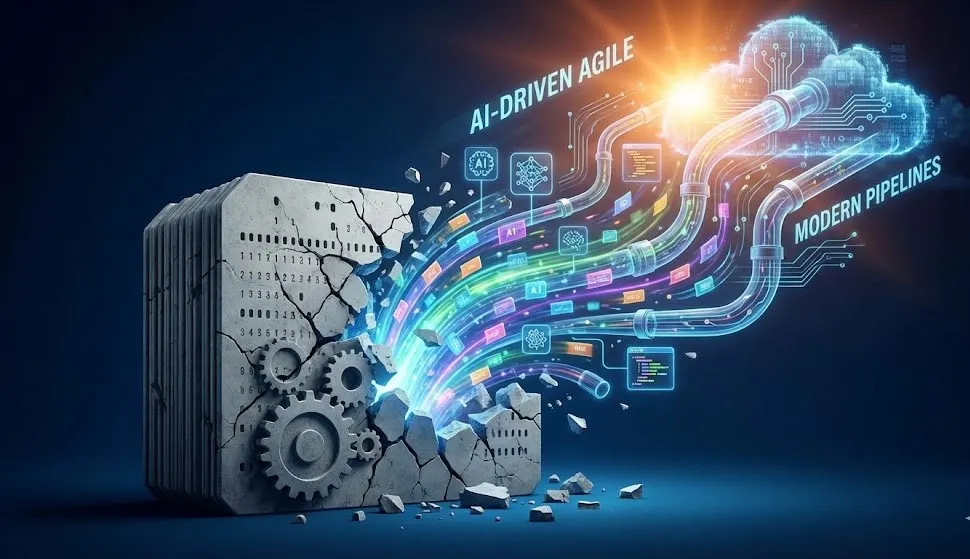
Core Workflow Principles
- Human-in-the-Loop Everywhere: AI generates code/specs; humans review and refine. Use escalation triggers like “confidence < 90%” for handoffs.
- Experiment-Driven Delivery: Treat every sprint as a hypothesis. AI runs A/B tests on features via tools like Optimizely AI.
- Ethics Baked In: Audit for bias at every stage; tools like Fairlearn flag issues pre-merge.
- No Burnout Zones: AI handles toil (e.g., log parsing via Sentry AI), freeing humans for creativity.
This “agile on steroids” boosts velocity. A 2025 Stack Overflow survey showed AI-native teams deploy 55% faster without quality dips. Embed responsibility early: Define SLAs for AI outputs (e.g., 95% accuracy) and clear paths for overrides.
Pitfall to Avoid: Scope creep. Use AI for planning; tools like Taskade generate realistic timelines based on historical data.
Step 3: Balance Speed with Security; Guardrails That Scale
AI accelerates, but velocity without security is a recipe for disaster. Identity sprawl (e.g., rogue API keys) and access drift plague 70% of teams, per Verizon’s 2025 DBIR.
Implementing Dynamic Security
- Zero-Trust AI: Enforce least-privilege via tools like Okta AI Guard. Agents get scoped access only.
- Runtime Monitoring: Use Lacework or Sysdig to scan AI-generated code for vulns in real-time.
- Hallucination Firewalls: Prompt guards (e.g., NeMo Guardrails) block unsafe outputs.
- Audit Trails: Log all AI decisions with tools like Arize for traceability.
| Risk | Traditional Mitigation | AI-Native Mitigation | Impact Reduction |
| Access Drift | Manual reviews | Dynamic RBAC via OPA | 80% |
| Code Vulns | Static scans | AI-assisted SAST (Snyk AI) | 65% |
| Bias/Hallucinations | Post-hoc checks | Preemptive prompts + human loop | 75% |
Integrate security as code; CI/CD pipelines with AI linters reject risky merges automatically. At scale, adopt “secure-by-design” frameworks like NIST AI RMF.
Step 4: Drive a Cultural Shift; New Metrics, New Mindsets
Culture eats strategy for breakfast. AI-native success hinges on empowering teams while maintaining oversight.
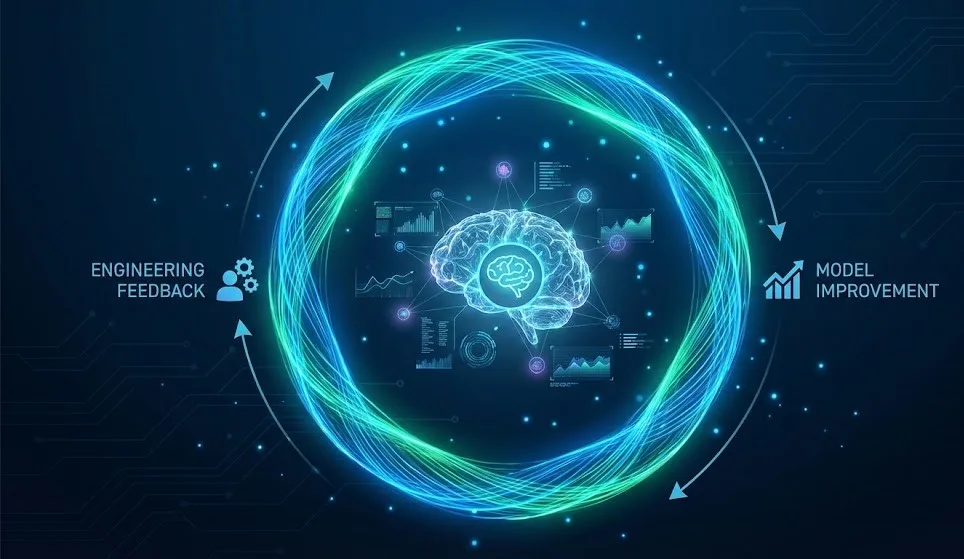
Evolving Success Metrics
Ditch story points for impact-driven KPIs:
- Onboarding Speed: Time to first PR (target: <1 week with AI tutors).
- AI Utilization Rate: % of tasks automated (aim for 50%+).
- Impact Score: Business value delivered (e.g., revenue from features).
- Error Recovery Time: How fast teams fix AI flubs.
| Metric | Target | Measurement Tool |
| Onboarding Speed | <7 days | Linear AI Analytics |
| AI Usefulness | 70% tasks aided | Usage dashboards in Cursor |
| Innovation Velocity | 2x features/quarter | Jira AI Reports |
| Trust Index | 90%+ satisfaction | Pulse surveys via Typeform AI |
Foster curiosity with “AI hack weeks” dedicated time for experimenting with agents like AutoGen. Leadership provides visibility via dashboards (e.g., Datadog AI Insights), ensuring autonomy doesn’t spiral into silos.

The Outcome: Dramatic Gains with Guardrails
AI-native teams deliver:
- Productivity Surge: 3-5x output, per GitHub’s 2025 Octoverse.
- Faster Innovation: Bottlenecks vanish; MVPs in days.
- Talent Retention: Engineers love amplified roles; turnover drops 25%.
But caution: Rushing without structure backfires. A 2025 Forrester study found 45% of hasty AI pilots failed due to trust erosion from errors.
Start Small, Scale Smart: From Idea to Execution
- Pilot One Pod: 3-5 engineers + AI stack. Measure baselines.
- Train Relentlessly: Use platforms like DeepLearning.AI for agentic workflows.
- Iterate Weekly: Refine based on metrics.
- Scale with Oversight: Roll out company-wide only after 3-month proof.
AI-native teams don’t replace engineers; they supercharge them. In a world racing toward agentic futures, those who master this hybrid model will lead.
Ready to build an AI-native engineering team that delivers real business impact; without chaos or risk? Let’s design your roadmap together.